Thanks for the effort, @Restrisiko, but trans-Atlantic passenger liners that competed for the Blue Ribband were not heavy cargo ships.
As I said above, comparing converted liners/troopships to heavy cargo ships is comparing apples to oranges.


Hi, we have now in the research tree transport ships.
Level 1:

up to Level 4
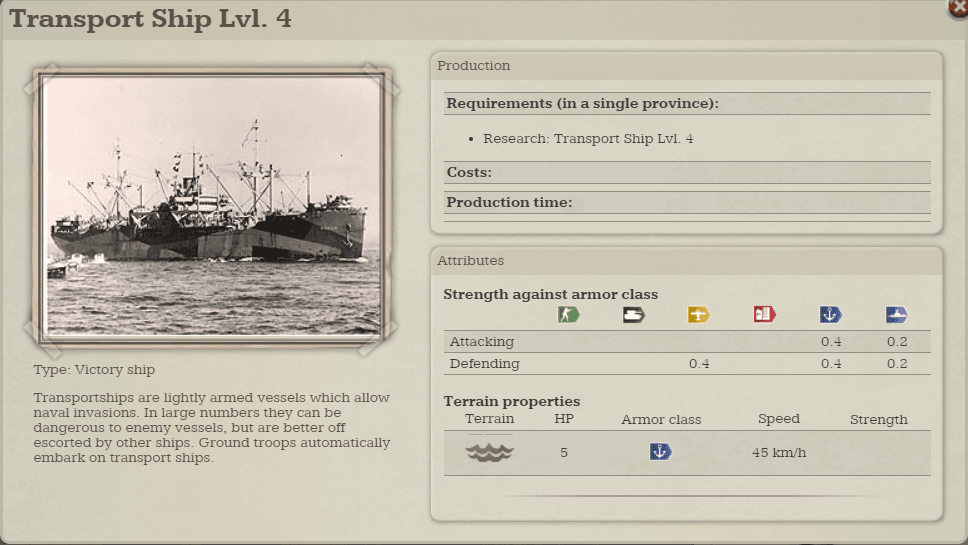
I like to have now this research option to improve the ship. But I think you have made them to fast.
Level 1 is running with 27 km/h = 14,5 kn.
Level 4 is running with 45 km/h = 24 kn.
A Battleship level 6 is running with 42 km/h in CoW. !!!
So most cargo vessels at the beginning of WW2 have a cruising speed from ~10 kn = 19 km/h. Okay that's to slow for CoW, but I think the devs must reduce the speed form level 1 to 24 km/h. Level 2 to 27 km/h (old speed of transport ships) up to 33 km/h for level 4.
Subs level 3 running with 36 km/h now, and they must have a chance to get the transport ships.
Please log in to post a reply.
Thanks for the effort, @Restrisiko, but trans-Atlantic passenger liners that competed for the Blue Ribband were not heavy cargo ships.
As I said above, comparing converted liners/troopships to heavy cargo ships is comparing apples to oranges.
Let's remember that the US ships were designed for a standardized speed. But yeah...MontanaBB wrote:
Here is the reality of 1945 state-of-the-art naval technology:Type XXI U-boat: 17 knots (31.5 kmh) -- submerged, faster than surfaced;
Gearing-class destroyers: 36 knots (67 kmh);
Juneau-class light cruisers: 32.5 knots (60 kmh);
Oregon City-class heavy cruisers: 32.5 knots (60 kmh);
Iowa-class fast battleships: 32.5 knots (60 kmh) -- full load;
Essex-class fleet aircraft carriers: 32.7 knots (60 kmh);
Midway-class large fleet carriers: 33 knots (61 kmh).
Moreover, these are the ships' top speeds, not their typical cruising speeds, which are usually 55 to 65% of their top speeds.
Also, the cruising speeds part is wrong on the percentage... 55 to 65% is usually what the speed is on submarines and transports, not larger warships. All of the ones you've mentioned(minus the type XXI) are made to cruise at around 15 knots. Fletcher class cruises at 15 knots(the Gearing is a modified Fletcher, basically. I looked at the Gearing's listed range on wikipedia(looked too short and too fast...) and then went over to the Fletcher's, as they are effectively the same), Essex is the same, Iowa is the same, and probably the others are very similar. Notice how all of them dip below the 50% mark... Usually closer to 45 or 40% on most warships. Some even dip below the 35% mark... Though not usually.
MontanaBB wrote:
As I said above, comparing converted liners/troopships to heavy cargo ships is comparing apples to oranges.
On day 32, the war was already many hard years old, and not only apples and oranges, but also a lot of other very different things were mixed and tried out..Restrisiko wrote:
They where simply rebuilt with level 4 - deck superstructures cut off and done - similar / reverse as with auxiliary aircraft carriers
This is an actual WW2 military transport ship, capable of transporting and landing troops during an amphibious invasion. Please note the presence of heavy cargo cranes and landing craft to transport troops and heavy military equipment, including armor, from the ship to shore in the absence of any shore-based dock facilities. Its maximum speed was 19 knots (35 kmh).
This is the RMS Queen Mary, during her war-time conversion to a troop transport ship. Please note the absence of heavy cargo cranes and landing craft. The Queen Mary was a passenger liner converted to transport large numbers of soldiers from North America to the United Kingdom. She lacked any ability to land troops during an amphibious invasion or otherwise in the absence of shore-based dock facilities.
Are we clear now?
@Restrisiko, my friend, you are obfuscating. I could write a dissertation on WW2-era ship conversions, including "jeep" carriers. For the record, escort carriers, either converted from existing cargo ships or new construction built on cargo-ship hulls, were limited by the same hull designs and propulsion systems as the cargo ships from which they were derived ---- typically 17 to 20 knots. Which was fast enough, because their principal purpose was to provide air cover and anti-submarine patrols for convoys which were even slower than than the escort carriers.Restrisiko wrote:
On day 32, the war was already many hard years old, and not only apples and oranges, but also a lot of other very different things were mixed and tried out..
Here's the bottom line: there was no heavy cargo ship or military attack transport that was capable of 45 kmh. It did not exist. So all the might-have-been conjecture here is so much bulls--t tossed around by people who have not done their homework.
Yes, all of the new-build major surface combatants of the U.S. Navy were built to at least match the speeds of the Essex-class aircraft carriers. Otherwise, the escorts would have been a drag on the principal capital ships. You will find, however, that U.S. Navy destroyer escorts (and similar ships of the Royal Navy) were designed with slower speeds to match the speeds of the convoys they were designed to escort. You will also find that new-construction U.S. Navy capital ships (battleships, aircraft carriers) were almost always 2 to 3 knots faster than their Royal Navy counterparts. Ditto for the Kriegsmarine's battleships. So the top speeds I presented above were state of the art in 1945-46.NovaTopaz wrote:
Let's remember that the US ships were designed for a standardized speed.
Well, ok for youMontanaBB wrote:
@Restrisiko, my friend, you are obfuscating. I could write a dissertation on WW2-era ship conversions, including "jeep" carriers. For the record, escort carriers, either converted from existing cargo ships or new construction built on cargo-ship hulls, were limited by the same hull designs and propulsion systems as the cargo ships from which they were derived ---- typically 17 to 20 knots. Which was fast enough, because their principal purpose was to provide air cover and anti-submarine patrols for convoys which were even slower than than the escort carriers.Here's the bottom line: there was no heavy cargo ship or military attack transport that was capable of 45 kmh. It did not exist. So all the might-have-been conjecture here is so much bulls--t tossed around by people who have not done their homework.

 - but I prefer to play a good game, which therefore dosn't necessarily have to be absolutely realistic.
My context was, there were fast (passenger)ships and it wouldn't be a problem in that time, to adapt them so (at Lvl 4 here, late in the war, and if they'll really needed then and it is nessesary to research them) that they can transport tanks or other militäry vehicles or war equipment, and that it is for me more then enough approach to reality for this game - the very most other things here in the game aren't and can't be right as in reality, but that's why the game is so good.
I agree that if the speed increase is small between levels, few are likely to research the higher levels. The exception might be on 100 or 50 player maps if you have to travel great distances.
The research is competing against other things the players can research. So far, in my FP games, I haven't researched above level 1.
If it doesn't significantly decrease the transport time to get somewhere, why bother.
Can it be produced now because I have it already researched and it doesnt show up on any of the unit tabs
Lets say you have a level one destroyer and a level 4 transport ship.
Does the transport ship add any strength to the group or no?
not really, just speedxXCooksterXx wrote:
Lets say you have a level one destroyer and a level 4 transport ship.Does the transport ship add any strength to the group or no?
...Xarus wrote:
It went up 0.1 in 3 levels... That's "impressive," but I guess speed is the main reason for upgrading is speed.Restrisiko wrote:
not really, just speedxXCooksterXx wrote:
Lets say you have a level one destroyer and a level 4 transport ship.Does the transport ship add any strength to the group or no?
Xarus wrote:
Transports are automatically created when you move land units into sea. They will just have the new level when you do.Dramos wrote:
Can it be produced now because I have it already researched and it doesnt show up on any of the unit tabs
@freezy: Can we get a info text or a symbol to see what level the transport ship are.
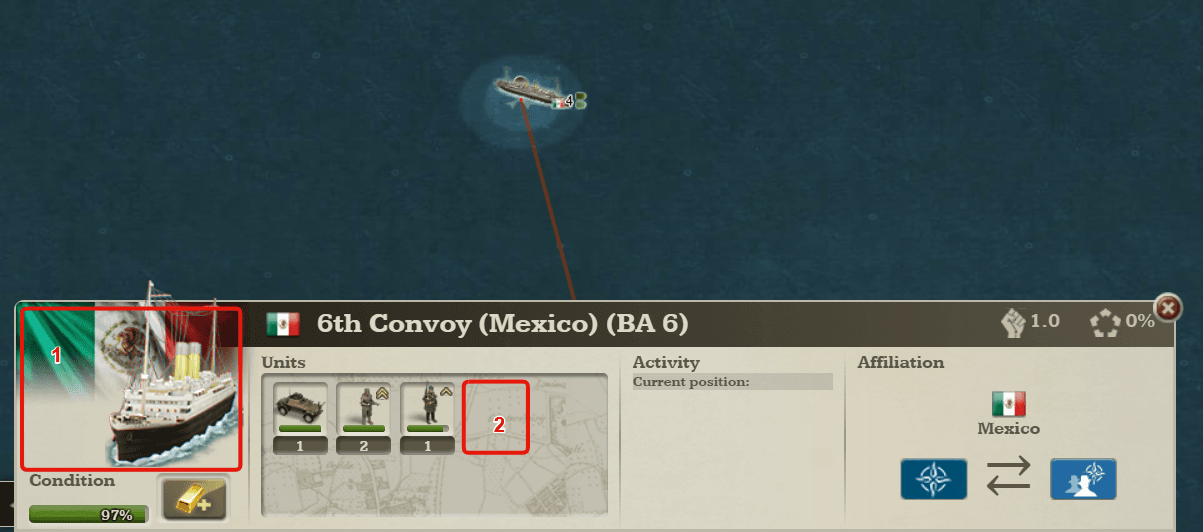

Maybe on position 1) With changing type of ships or at position 2) with they own symbol and the arrows for the level. Better to put the ship to the left and the units that be a part of this convoy light shaded.
It is probably to late now but I think that instead of increasing the speeds so high a different option should be considered. It would be to have the new level 1 stay as they are. Level 2 speed is the same as the L1 but instead embarking and disembarking times reduced by 5% sort of like using a Naval Base. Level 3 speed would be as the new Level 2 speed is. Finally Level 4 the speed would be the same as L3 but once again reduced embarkation and disembarkation time by 15%.
My proposal
L1 speed 23 normal load/unload
L2 speed 23 5% reduction to load/unload times
L3 speed 30 normal load/unload
L4 speed 30 15% reduction to load/unload times
Is always goodMontanaBB wrote:
Slow down. Think before you act.
 ))
))But lets test them first.
S Schmidt's idea with the reduced unload times instead of speed increases is also very attractive; especially for invasion forces.
No matter what, I love the addition already.
Bytro has the habit of testing in FP for technical bugs only, then moving it into production before anyone can say "boo". Ideas are rarely, if ever, tested for merit of content, or at least, not in sight of us mere mortals._Pontus_ wrote:
Is always goodMontanaBB wrote:
Slow down. Think before you act.But lets test them first.
So, we have now the Transport Ships for some days tested. I have to say that the speed of the ships is to high!
The balance is now out of control at sea battle. We have to research 6 different class of warships and some of them have not the speed to reach the transport ship when they spottet.
Please reduce the speed for Level 2-4! Maybe give the next level transport ships a bonus to embark or a bit more defense against subs but they are to fast.
Or maybe add 2 more levels, reduce the 2-4 speed, and make transport ships available around the time of the fastest warship research?Xarus wrote:
So, we have now the Transport Ships for some days tested. I have to say that the speed of the ships is to high!The balance is now out of control at sea battle. We have to research 6 different class of warships and some of them have not the speed to reach the transport ship when they spot it.
Please reduce the speed for Level 2-4! Maybe give the next level transport ships a bonus to embark or a bit more defense against subs but they are to fast.
Please log in to post a reply.


