Day 8 to day 10 - Grand undertakings !
As the Dominican Republic was still licking its wounds from the costly meso-american conquest, a huge news fell on the desk of the Savior !
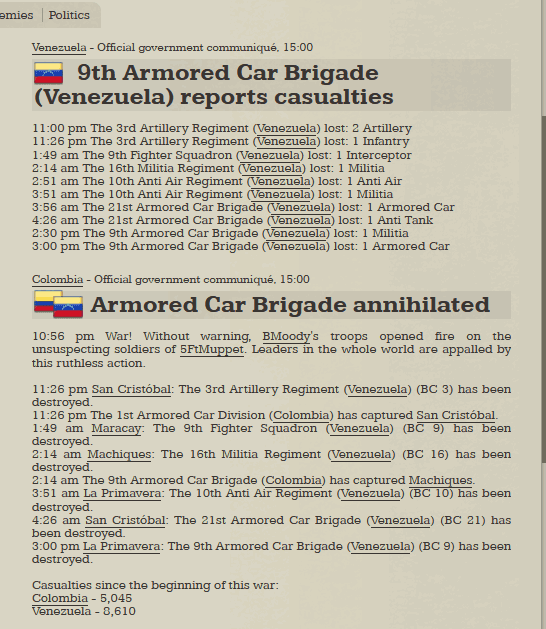
Colombia, a country with great ambitions and poor impulse control had attacked Venezuela... and clearly the attack had not been overwhelming.
In addition to high losses, the attack had clearly petered out quickly.

This could be game-changer as it left both Colombia and Venezuela vulnerable from a lightning strike. Of course, Venezuela had been earmarked for re-christianisation for a while, due to all its cities being in range from a battleship that the Dominican Republic would happen to have. Still, maybe the Christian Republic should act faster than initially planned.
For its grand assault on Colombia, the Dominican Republic could rely on :
- 4 commandos
- 1 battleship (another one was being built)
- 1 submarine (protecting the Panama canal
- 2 destroyers (1 protecting Santo Dominguo)
- a 60% depleted stack of 3 militas, 1 AT gun and 2 AA guns.
And that was all.
And the Savior Said : "I think I can work with this".
Indeed, there were a few peculiarities of Colombia that the Christian Republiccould use. First, Colombia had received significant losses already again Venezuela, and most of the force would be on front, not guarding the rear. In addition 3 of the 3 Colombian cities could be bombarded from the sea. The only one "safe" was the capital.
Therefore, here was the plan :
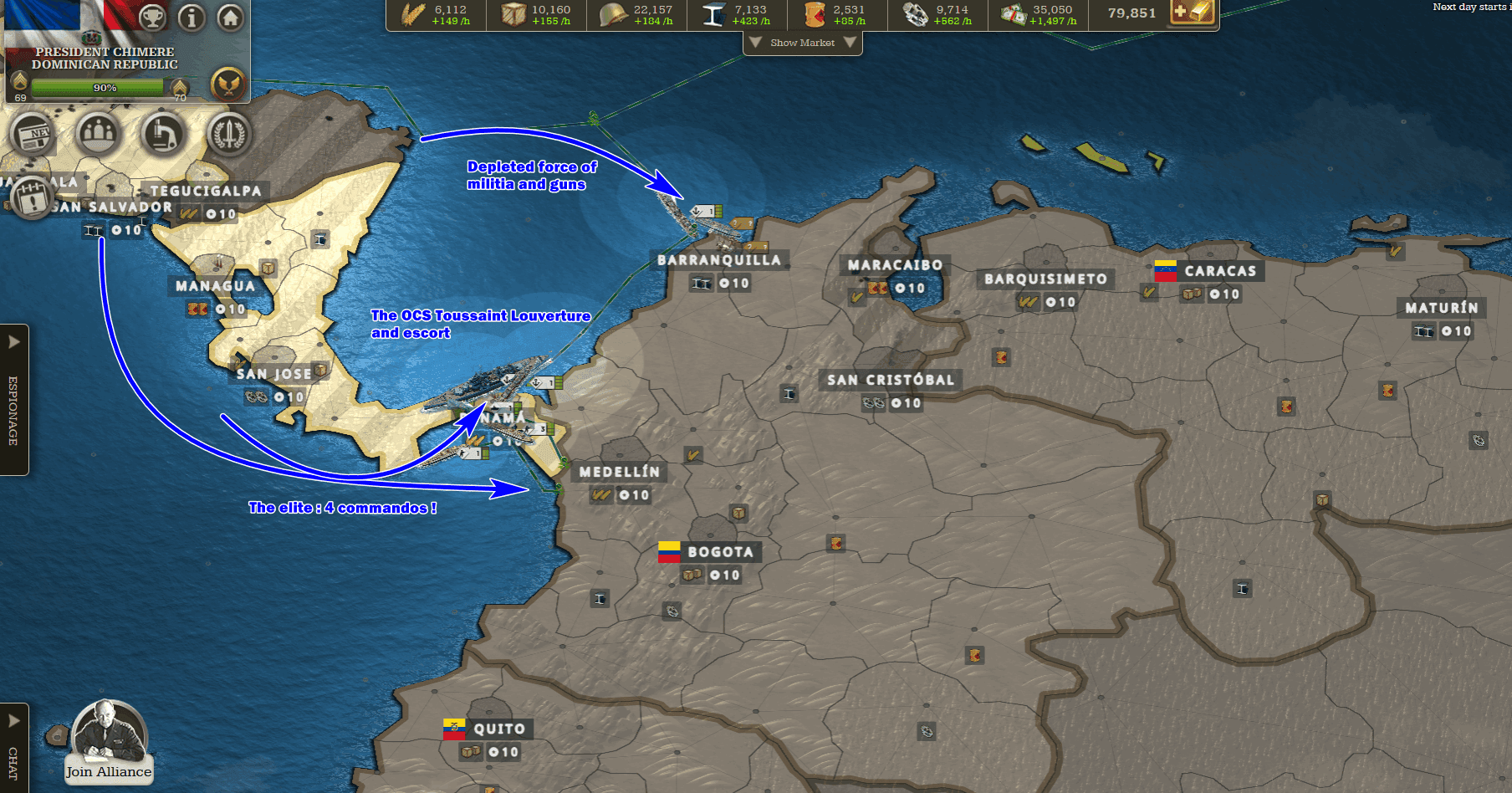
- 2 spies would be deployed one on the frontline, one in Bogota to see what kind of force Colombia had
- Invisible commandos would be deployed from Panama. The would walk through the mountains south of Medellin ("Manizales") and from there march directly to Bogota before it could be reinforced. Between Manizales and Bogota, the march would take 1 hour maximum, not giving any time to reinforce to the enemy. For this reason, there would be presumably 1, maximum 2 units in defense.
- The depleted militia army would land North with support from the battleship. Losing this army was not seeing as much of a problem - it was costing no less than 15%-20% of the country food output in maintenance alone !
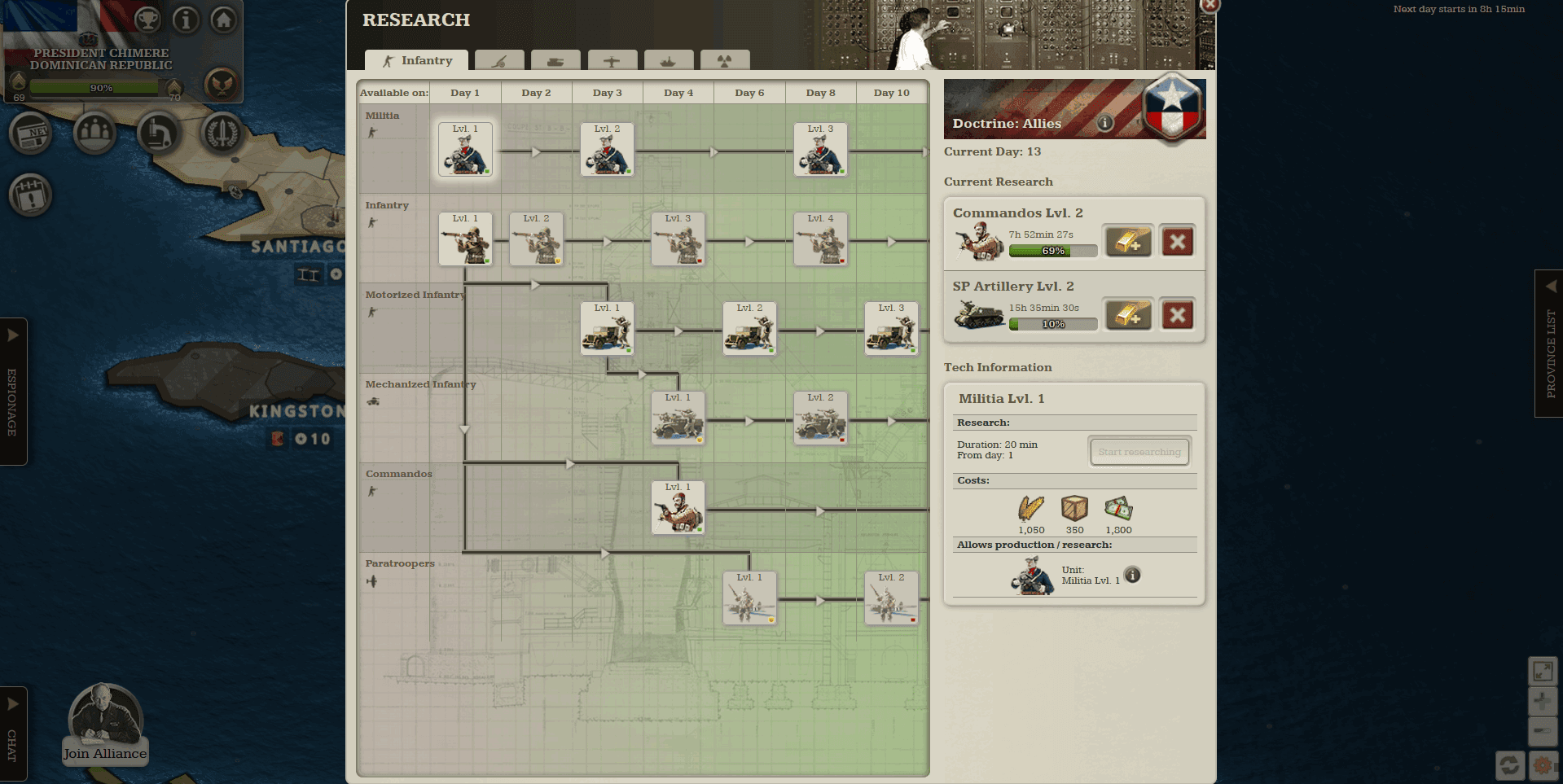
Of course, this meant improving the commandos : an expensive but necessary change :
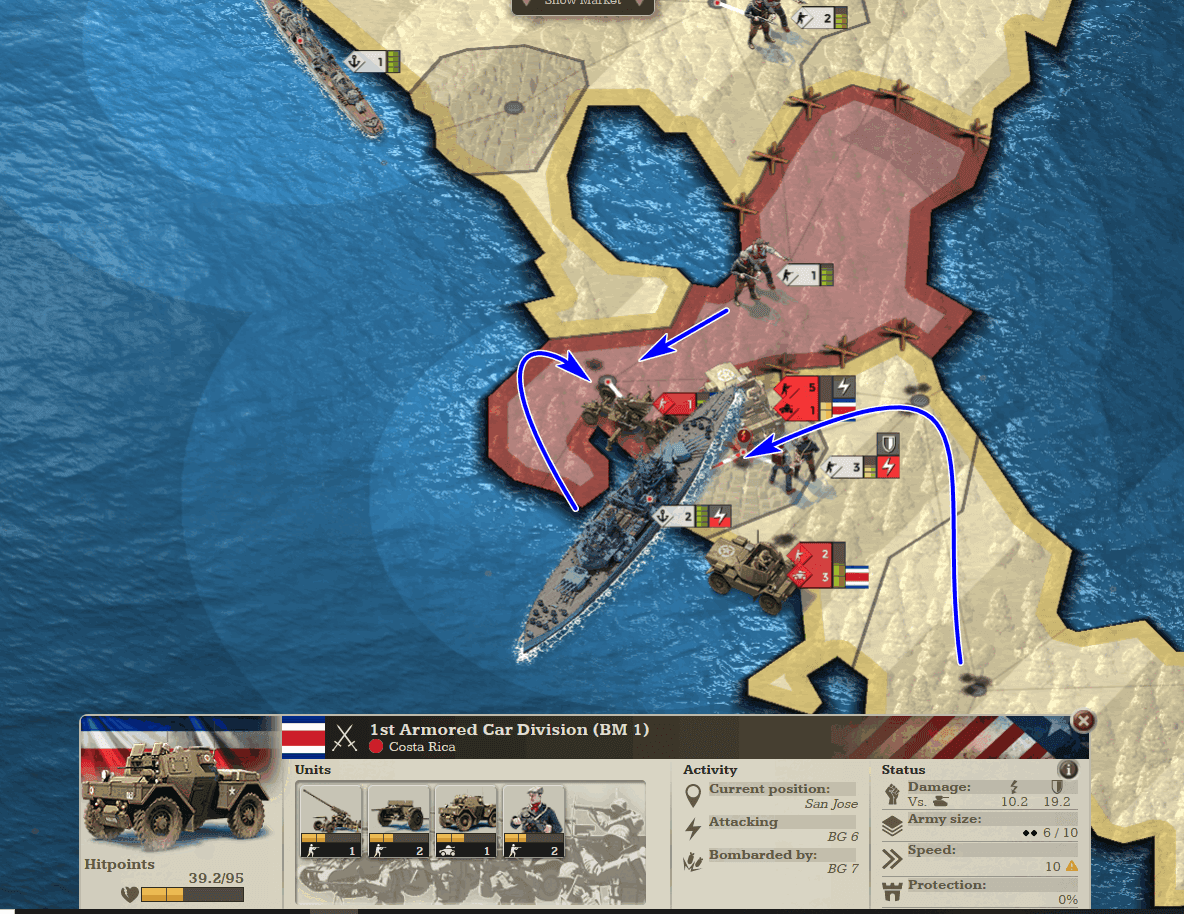
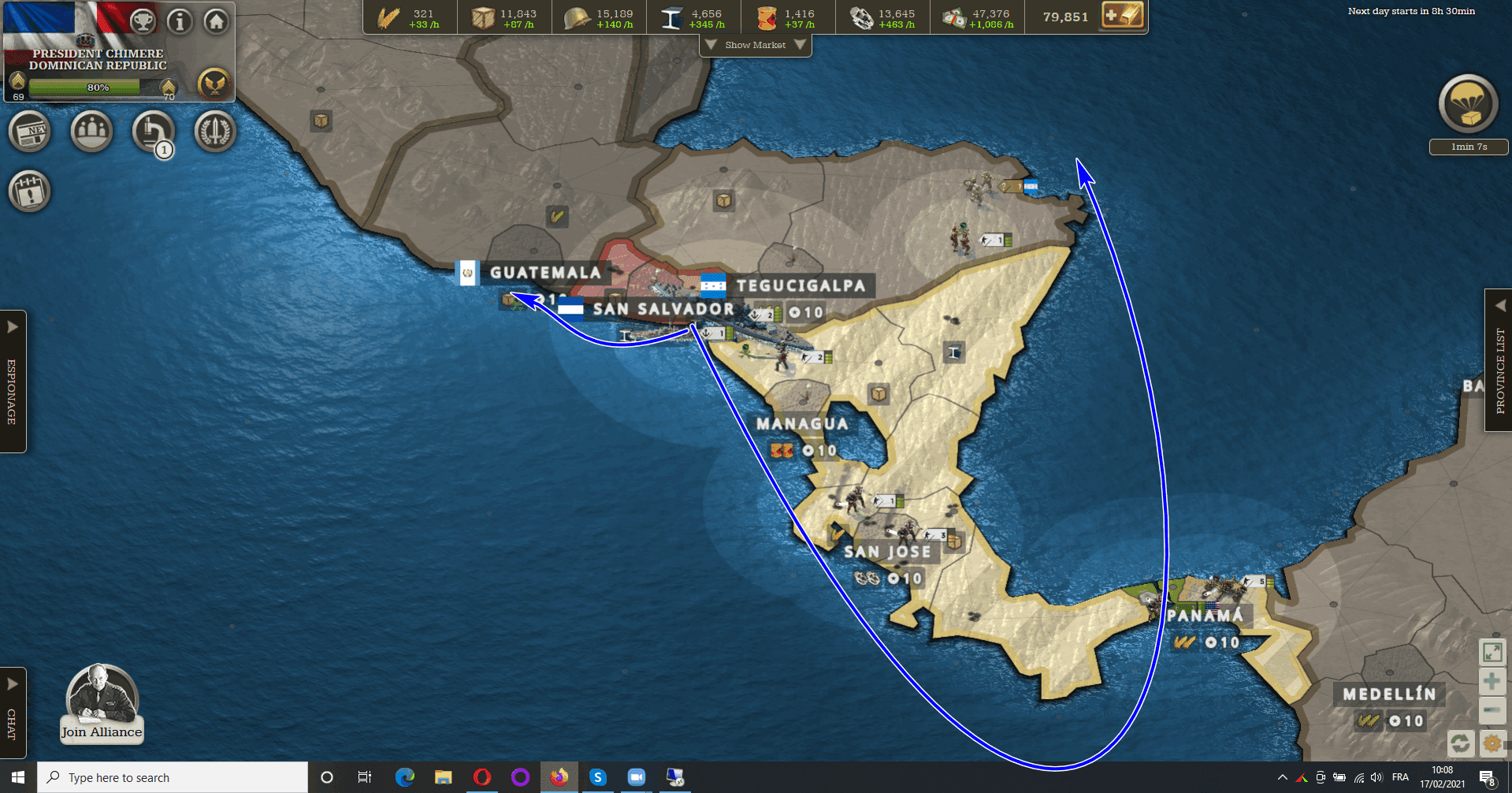
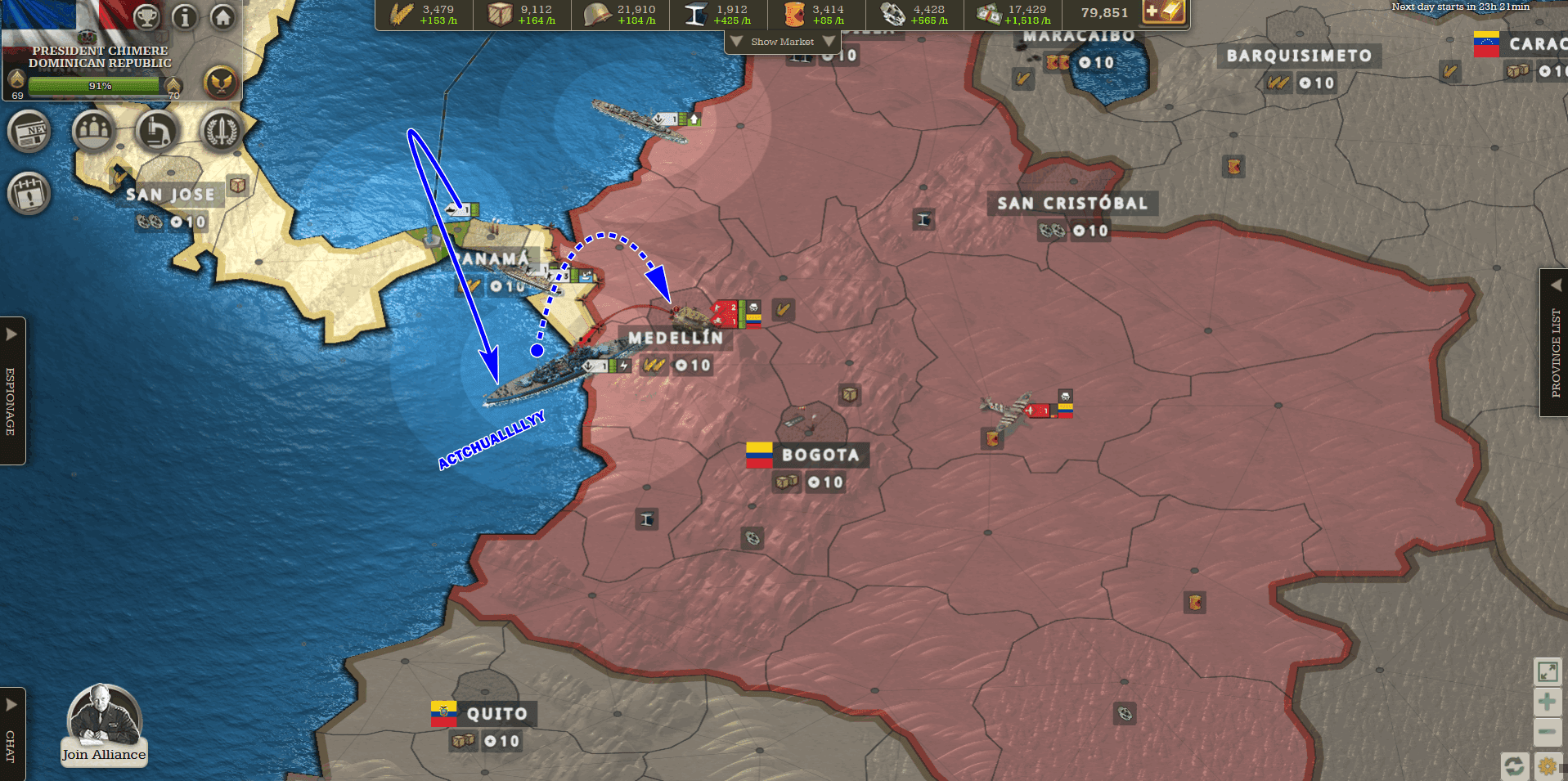
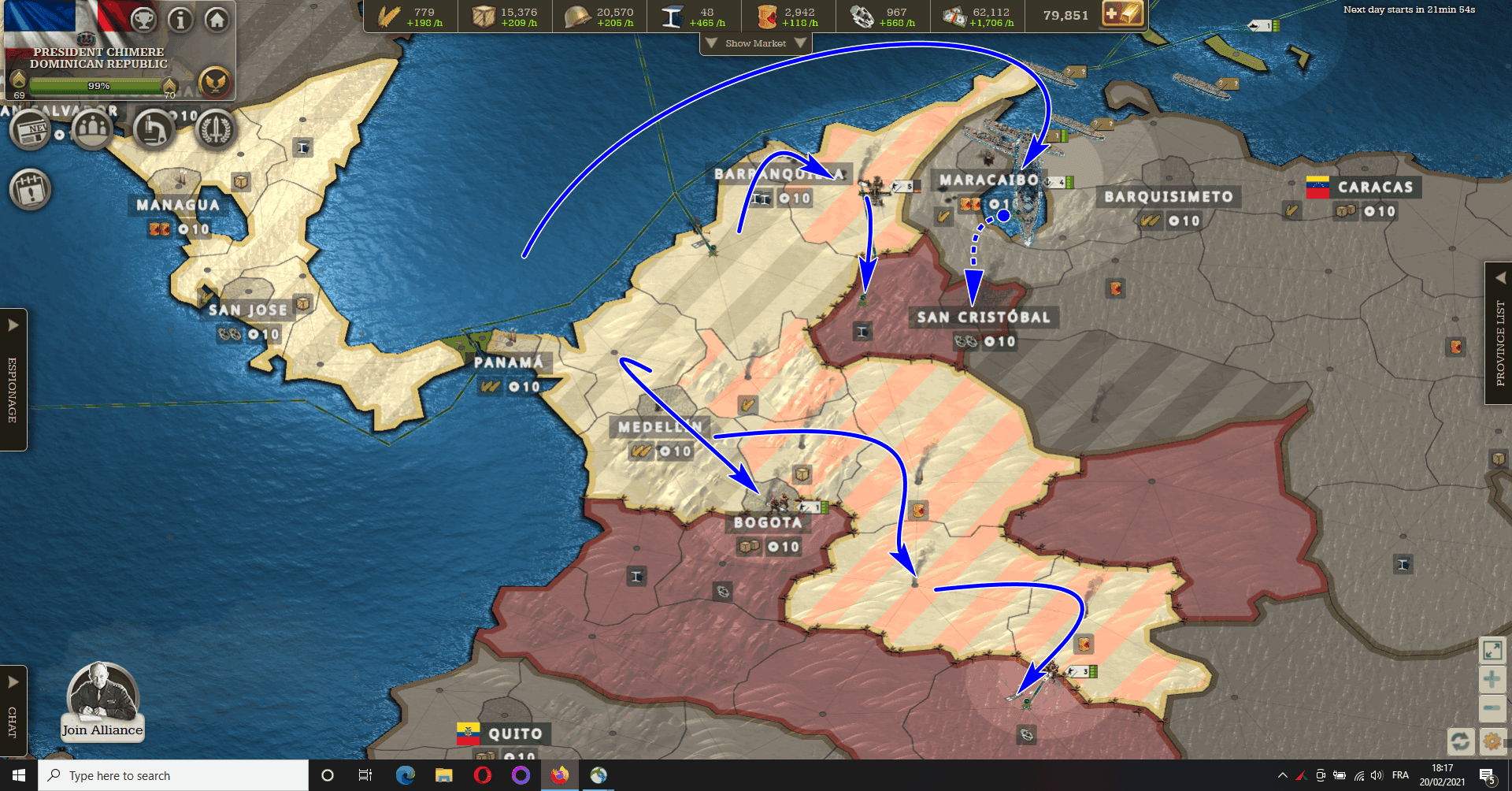
Of course, the plan did not survive reality and the Savior impatience. More critically, a STRONG armored force was detected by the spies in Medellin, a force that could destroy the commandos, which meant it had to be destroyed, which meant the battleships had to be rerouted to clear the way from the commando - starting the war as soon as day 8, rather than day 9 as expected :
Early day 9, the armors were either destroyed or in flight. The commandos started the move toward Bogota :
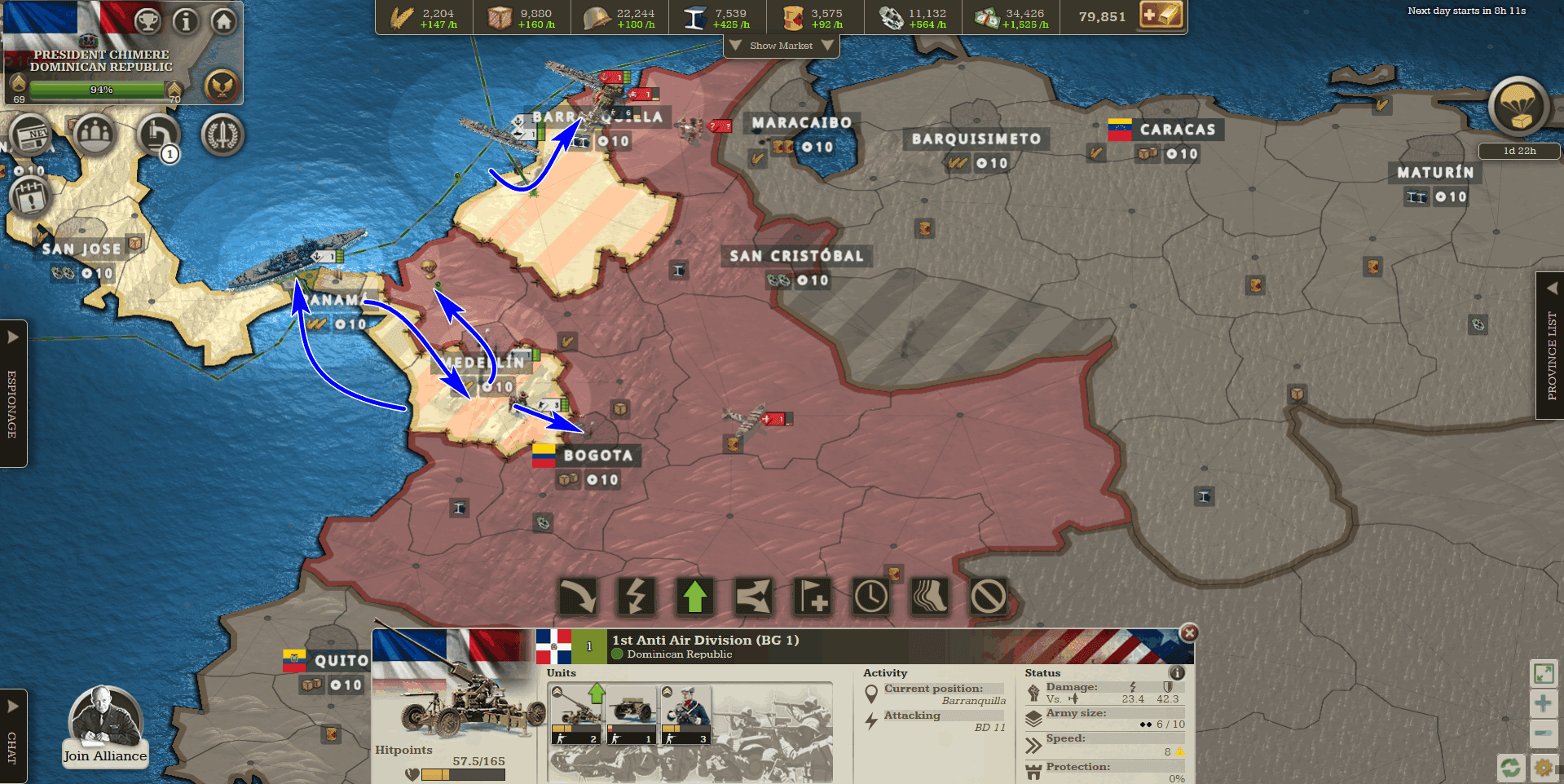
In the North, the landing had proceeded normally, and the militia army was moving toward Barraquilla, with the OCS Toussaint Louverture on its way to support .
As hoped, Bogota was not defended - that artillery would not see the commandos until too late :
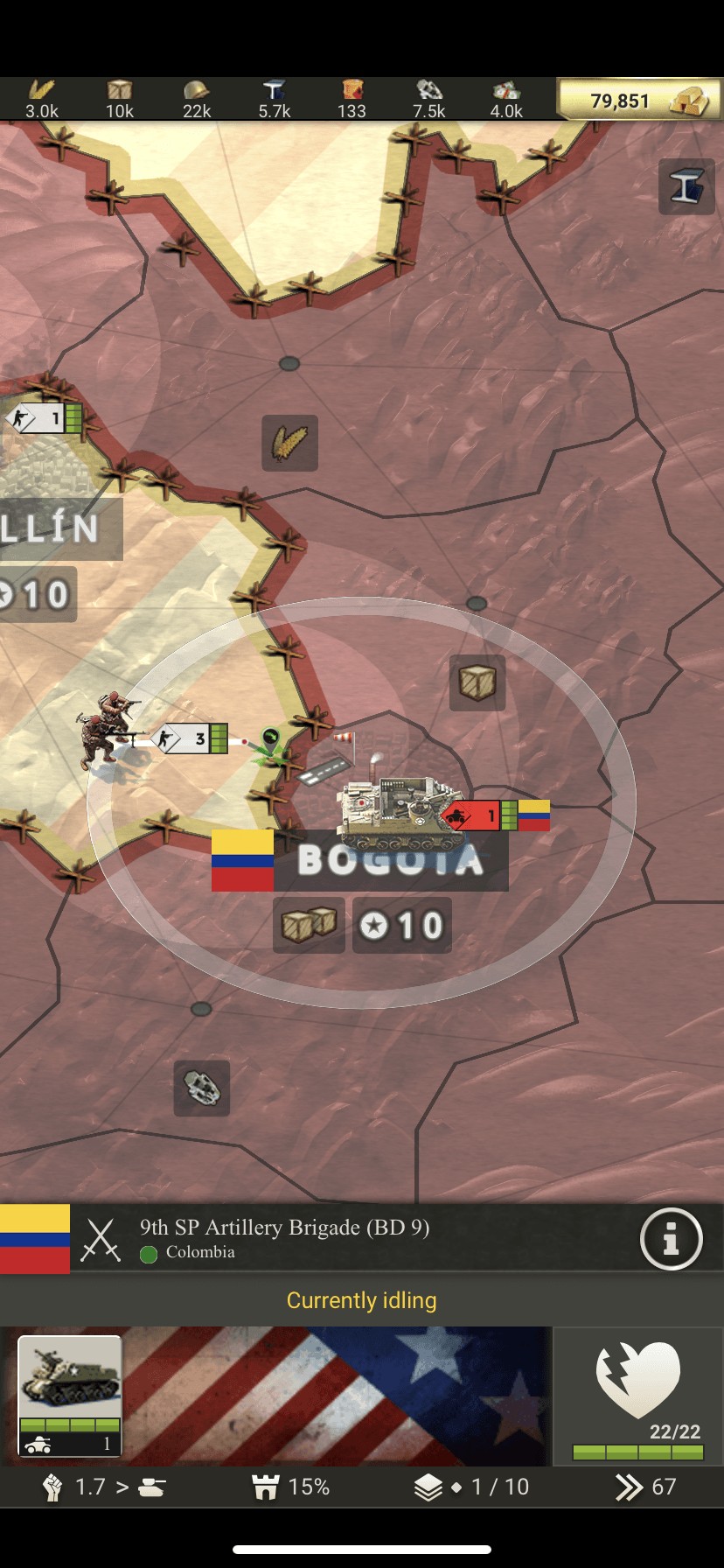
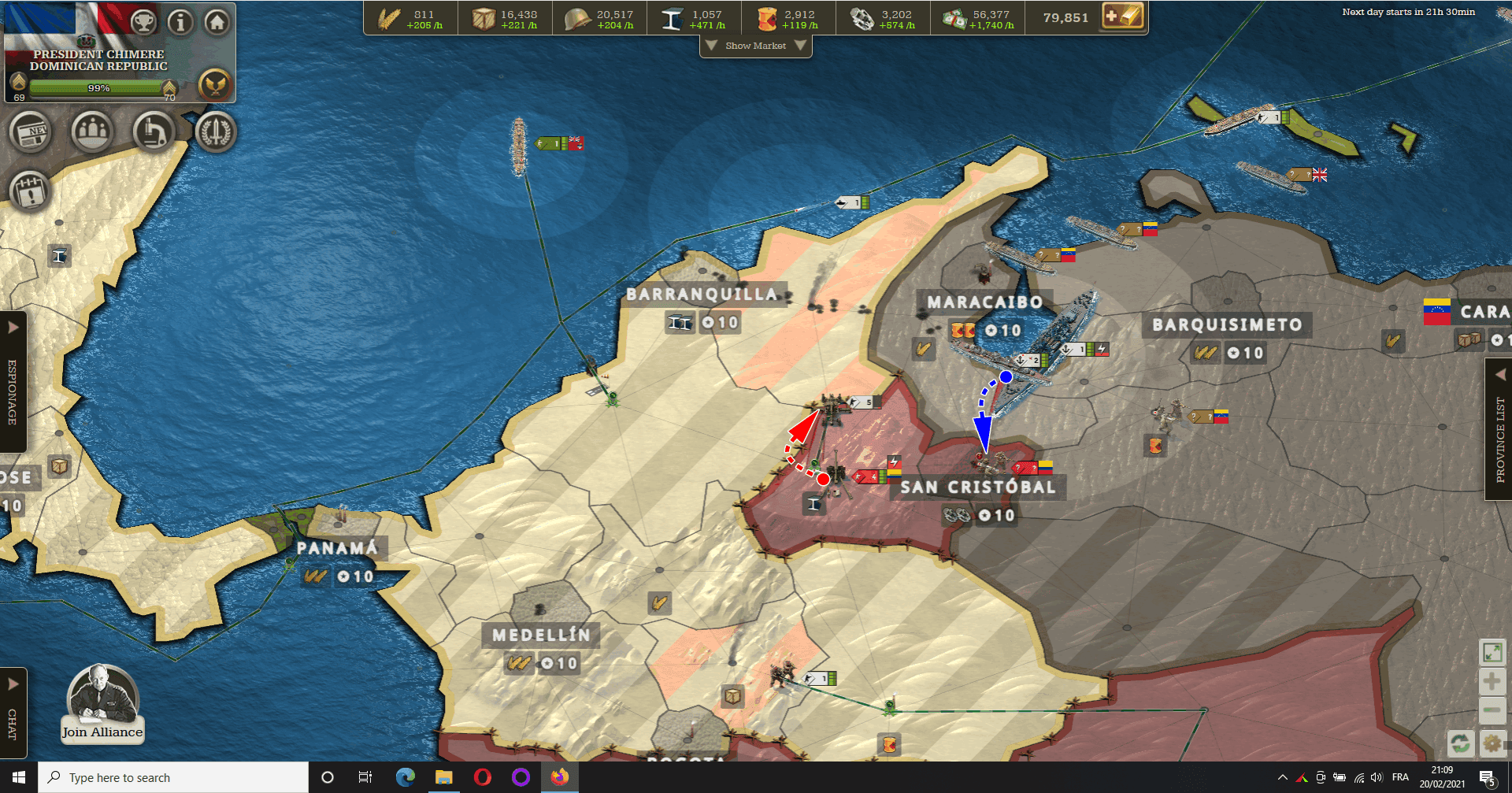
By mid-day, Colombia had lost all its core cities, with only the former Venezuelian city of San Cristobal in its hands - even then San Cristobal was under fire from the OCS Toussaint Louverture from Lake Maracaibo.
The heights of San Cristobal were defended by artillery. The militia of Santo Dominguo, raised to defend its country against the Haitians, was ordered to attack relentless. What they did not know was that they were now considered a burden for the project of the Savior. They, who had fought relentlessly in 7 different countries, had been ordered a foolish order that could only result in their destruction. They were a relic of the past, useless certainly, and costly too.
The militia army was virtually eliminated.
In the South, it was time for mop-up. Sadly, one of the commando regiment encountered an enemy tank regiment, and they were annihilated.
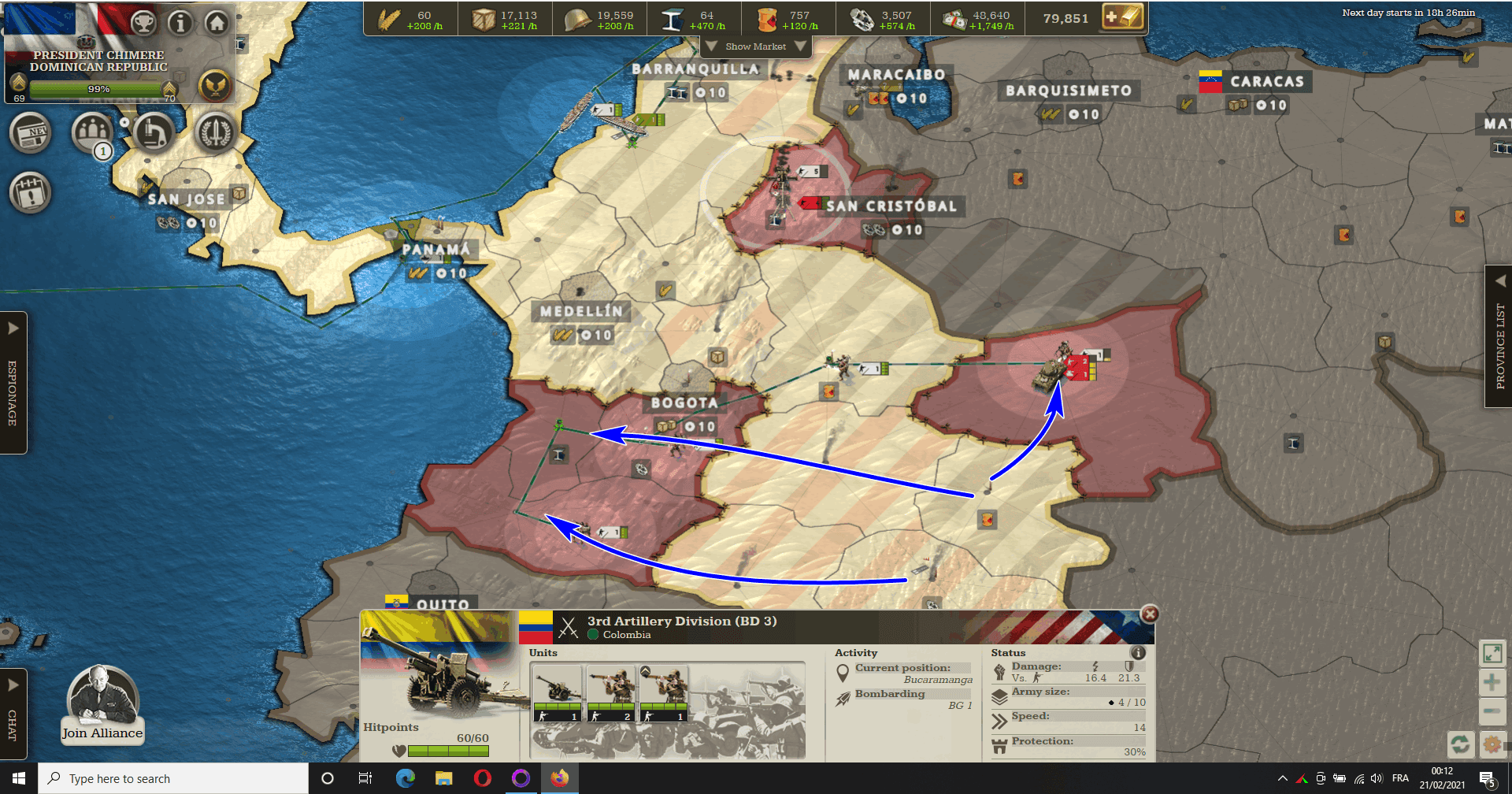
By the end of day 9, the total Dominican army was :
- 2 battleships - one in production
- 3 destroyers (1 protecting Santo Domingo still)
- 1 submarine (protecting the Panama canal)
- 3 commandos
- 1 motorized infantry (in the Dominican republic itself)
At least, maintenance was not much of an issue.
Due to his limitation, the final mop-up of Colombia would have to wait - there was no way for instance to destroy the artillery protecting the access to San Cristobal - though it was only one battery.
In addition, there were other pressing matters :
- In Europe, an unexpected alliance of Romania, Persia and Turkey was taking over Eastern Europe, destroying Poland and warring against the Soviet Union. Germany, France and the United Kingdom were totally inactive.

- More worryingly, in Asia, Japan had defeated China, and was on the verge of occupying it entirely. The Chinese government had fled to Mongolia

Japan was on the verge of becoming a superpower.
In America, USA had declared it wanted no parts in the International Diplomacy and became inactive. It had been replaced by Australia.
The Dominican Republic knew that Japan was definitly not Christians, unlike the Dutch, the Canadians and the Australians (though those were the wrong kind of Christian), so the Savior knew he had to organize them against Japan.
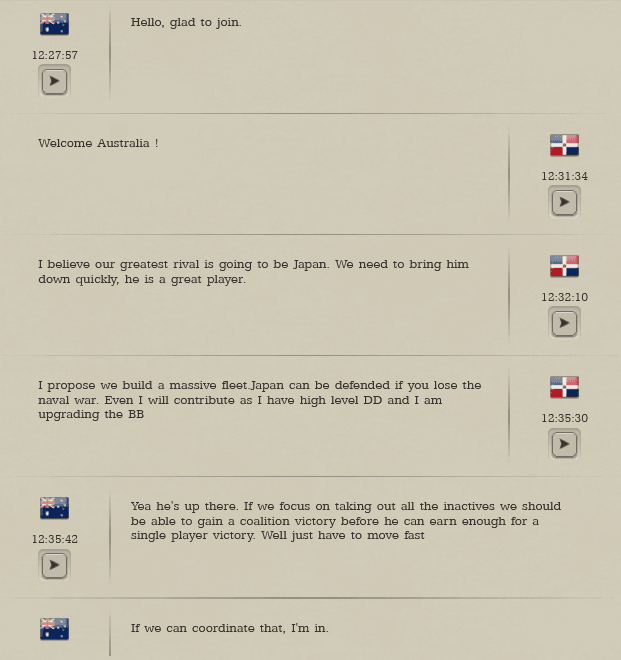
Australia was eager. Its country had been industrialized. Its army and fleet was modern and well organized !
Netherlands maybe needed some convincing ? And Canada some, errr, explanations ?
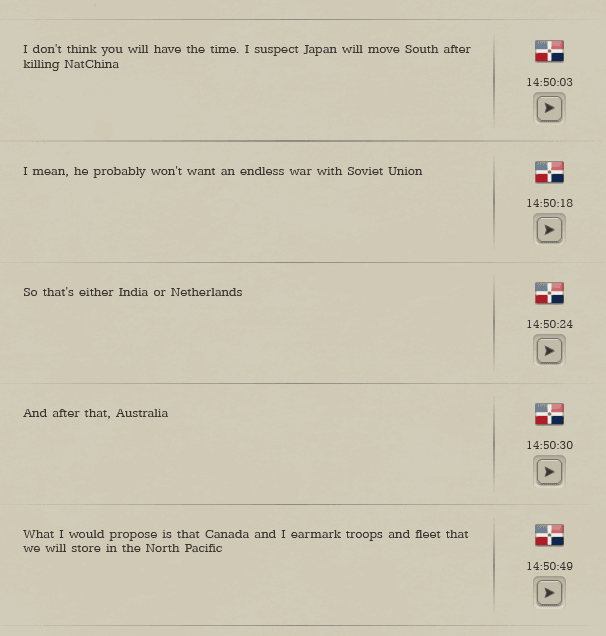

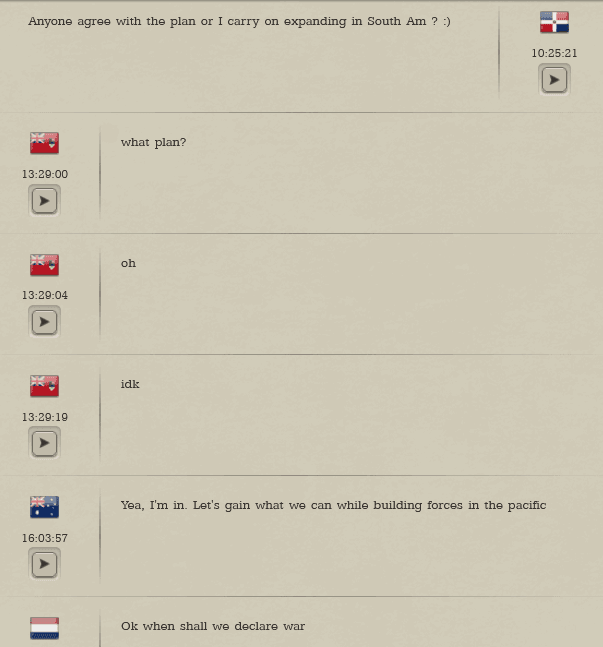
Well, Netherlands was also eager. Canada, eh, it was being Canadian about this whole "war" thing.
The Dominican Republic first explained its initial plan :
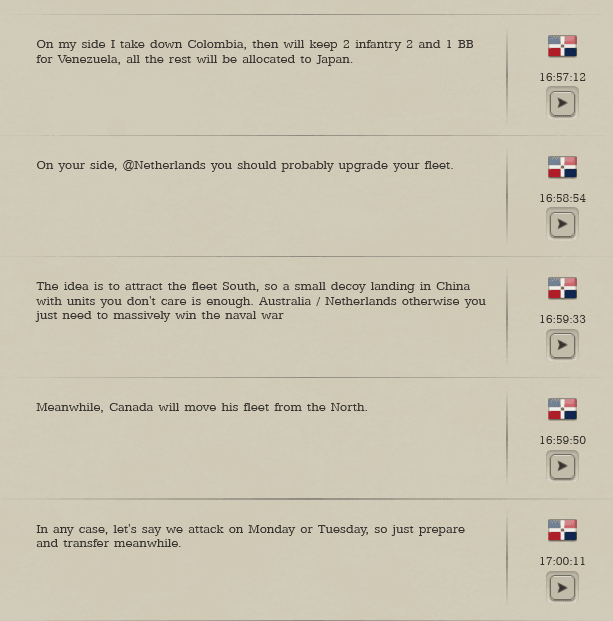
But it was maybe a tad complicated given the coordination issues, so it did not show the nice map it had prepared :

Netherlands had the largest fleet, though it was certainly not modern. Even old ships could scout in peacetime though :

On the other hand, Canada had not developed its fleet from the peace era :
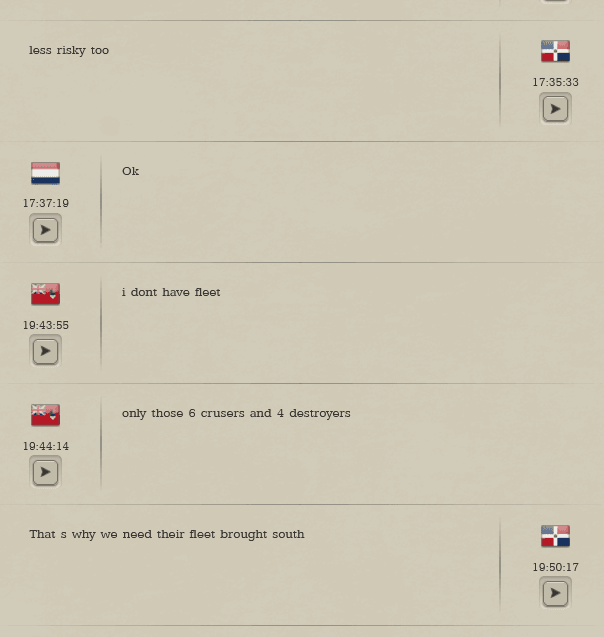
There was a strong sense of herding cats, and the Dominican-Canadian-Dutch-Australian (DCDA) Command coordination was not looking good.
For this reason, the complex plan gave place to something more simple, known as the "fat multinational stack" :

There was another issue : Canada and to a lower extent Netherlands were lacking behind in terms of industry :

They did not quite realize it
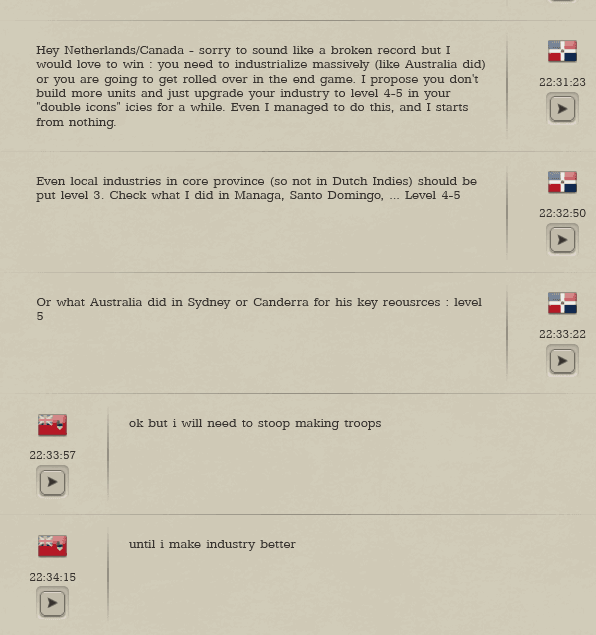

Well, just like that the DCDA Command became the DDA Command against Japan. But at least Canada committed to industrialize from then on, and it did. So did Netherlands, though unlike Canada it had started on its own, and was more lackluster in the "army modernization" department.
In any case, the Dominican Republic had made a promise, and it had to deliver. On the 10th day, the small Dominican fleet (2 battleships 2 destroyers) was sent, along with the motorized infantry in Santo Domingo and the commandos in Colombia (seen regrouped before embarking below) :

Colombia was not finished off, but the Dominican Republic had to contribute to the defeat of Japan even symbolically for the coalition to hold. The conquest of the rest of Colombia would wait for the new modern army that the Christian Republic was now building with the many resources it generated through new trade, which will be explained in the future days.
As for the Japanese invasion force, it would take it 2 days and half to arrive in the general Japanese area.



 .
.