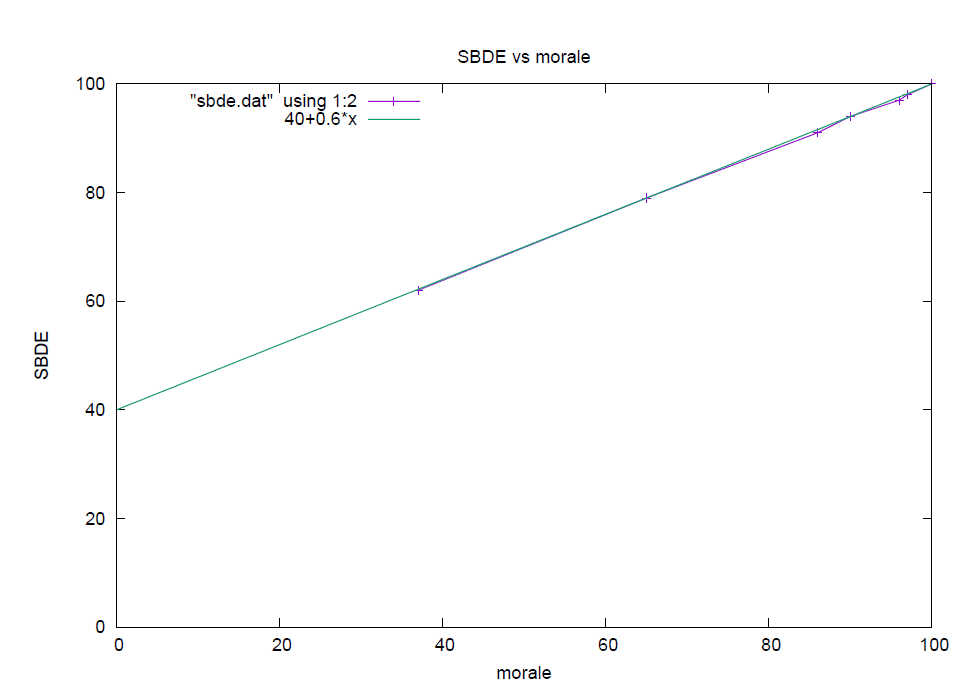
Hey guys. I figured out the equation for State-based damage efficiency (SBDE) for stacks at max efficiency (lower stack sizes). The SBDE starts at 40 for morale 0 and goes linearly to 100 with slope 0.6. The equation is 40 + 0.6 * morale. Below is a plot showing the equation vs real data. This holds for all the unit types I have looked at. Next I would like to figure out the equation(s) for the higher stacks, which I could do myself but all my troops are spread out too much to get big stacks. I think we could figure this out quickly if people can post some info here. If you could post in this format on one line it would be most useful:
my apologies if it seems like am hijacking the thread. maybe we should start one for the "TEST BOARD"?
I am not sure what protocols/conventions are followed here yet and I did not mean to cause any offense.
I just thought of the idea and posted since it seemed to tie into the data collection. Some guidance from some of you "old timers" on these forums would also be appreciated. I am not sure if there is a casual approach to subjects or if the 'rules lawyer' comes out when a thread tends to stray off topic.
please advise.
regards.
Given that the test game would hopefully be covering more than just SBDE, I'd say make a new thread. There will surely be lots of setup discussion regarding the game as well, so we can continue to post SBDE results here.
21 Jan 2016, 00:13
Javman wrote:
So I've probably gone a bit insane
Nice. So this clarifies a few things. For the INT6 I was able to get a good fit with the function SBDE = 5.67937 + 602.612 / troop_count. This curve is shown in this updated plot. Doing this I realized what the previously mentioned "wiggle" was all about. They are "fudging" the first value or two from the optimal troop counts. In this curve fitting, I excluded INT6 troop counts 5 and 6 because they do not behave like the other points, which are all similarly proportional to 1 / troop_count. You can see this shift from optimal for BB, SP, tanks and INF also, not sure about subs. I imagine they "fudged" the first one or two points after optimal because they wanted a function that was inversely proportional to troop count, but they didn't want the first troop or two over optimal to give such a drastic plunge in SBDE.
21 Jan 2016, 02:28
I went ahead and estimated the curves for BB and M tanks as well here. The fact that the M/H and the planes both have the same values for the first 4 points and then diverge makes me think that these 4 (or the first 3 after optimal) are fudged. So here for M tanks and INT I am finding the optimal curve fit for the points from troop_count=9 on. For battleships I am using from 7 on. The plotted curves are not the optimal fits, but sensible whole numbers I picked that were close to optimal given the data. In all cases I'm assuming the minimal SBDE is 5%, at troop count infinity.
21 Jan 2016, 10:03
188 Subs = 9 %
I don't get exactly what you want with this data, it's not like there is a holy grail to find, just don't stack too big.
I would much rather know how the SBDE actually affects the damage? I mean does 23% SBDE mean that the stack only gives 23% of its damage? Because I dont think that's the case.
Thanks wild. Is that at 100% morale? If possible could you give a few other points say every 20 or so so 30 and then every single to 12 which is where are current data stop? Yes, this is a bit academic. I think we are just doing it for fun, like wasting our time playing a game. Some people ....
Well based on the post DxC you just posted, it doens't seem that you know it yourself..
know what? the relation between SBDE and morale is strict and simple. Look at the plot in the first post on this thread. Geez. SBDE = (40 + 0.6 * morale) is the equation for optimal stack size. The rest of this thread addresses non optimal stack size.
It would also be very interesting to know how much damage they deal besides knowing how efficient they are. For me this gives the SBDE some practical use.
For example.
1 unit deals damage with 100% efficiency, lets call this damage value 'X'.
The formula for total damage in function of different numbers of units would be "total number of units * X * SBDE". Ideally we want SBDE to be 100%, but we know it will start to drop at a certain moment and we really would like to know how much extra damage we imply by continuing to stack up more units. This will be more usefull ingame than SBDE alone.
Tac Bombers for example:
1 TB * X * 1.00 = 1X
2 TB * X * 1.00 = 2X
3 TB * X * 1.00 = 3X
4 TB * X * 1.00 = 4X
5 TB * X * 1.00 = 5X
6 TB * X * 0.93 = 5.58X
7 TB * X * 0.89 = 6.23X
8 TB * X * 0.81 = 6.48X
9 TB * X * 0.73 = 6.57X
10 TB * X * 0.67 = 6.7X
The extra damage output that the 8 or even higher number of tac bomber in your stack offers is almost negligible.
27 Jan 2016, 08:25 (edited)
Well based on the unit strength (the fist in upper right corner when you click on unit), the normal strength is simply multiplied by the SBDE as one might expect. The "fist" strength always seems to correspond to the highest attacking strength, but it seems reasonable that the other combinations of strength are likewise multiplied by the SBDE. The actual damage observed in battles varies widely, but I would still assume the average expected strength is strength*SBDE. There is just a high variance around the expected value. Thus, your X above is a random variable, not a constant. Probably the best one could do is figure out what the frequency distribution of this random variable is. For example, is it normal with a standard deviation of S? Does it have upper and lower bounds, etc?
27 Jan 2016, 11:42
You are correct, I've not taken the random factor into account. I simply presume it will be the same for all units, in offence and defence, against every kind of oposing force, but we can't know for sure... atleast not yet.
The X is indeed influenced by a random factor, but it allows me to make a usefull comparison between having 6 bombers to attack, 8 or 10. Now I'm sure I will max almost always at 8, so I'll still have good damage after losing 2, but also knowing that having 1 or 2 more doesn't really make a lot of difference in damage output.
P.S. The strenght indicator in the top right add up the highest def or att value, not only the attack value (explaning why anti air is so """"powerfull""""). Not sure if you didn't know or just mistaken in above post.
P.P.S. I also wonder if the random factor is the same after having bombed someone while patrolling and after it did some patrolls and you order it to do some "real" bombing.
30 Jan 2016, 22:06
The added HP that you get with using more planes for instance could also have a big effect, no?
In a hypothetical battle the damage spread over 10 planes vs 7 planes could mean that you loose a plane when only attacking with 7?
1) The added HP that you get with using more planes for instance could also have a big effect, no?
2) In a hypothetical battle the damage spread over 10 planes vs 7 planes could mean that you loose a plane when only attacking with 7?
Right?
1) Maybe, who knows. Do we have any data? Like for example taking less damage in total? Or more like the damage spreading that you suggested in 2) (I numbered to make replying a little easier for me).
2) As far as I understand of how the battles work, the damage received is not equally spread over all units of the same type, but the last one in the stack receives it all. In game they also drop down from 7 TB --> 6 TB --> 5 TB untill they reach 0 TB. The way I interpretend your reasoning is that all planes would take damage untill they all would drop to 0 health. They would go from 7 TB (or 10TB) straight -------> 0 TB, without countdown like above. I probably misinterpreted your suggestion .
1 Feb 2016, 19:08
Well, if you split your stack into single units they will have the same HP.
More correct, they die one by one. The damage is spread until a critical point where one unit in the stack dies (they merge into 100% stack)


 [/img]

 .
.


