A GENERAL OVERVIEW OF DEVELOPMENT
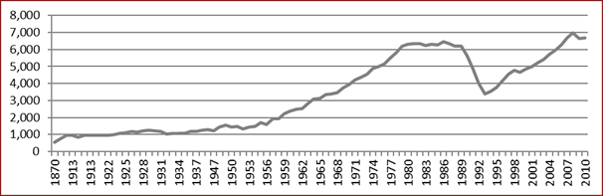
The data on Yugoslavia’s development is not unknown and therefore it is unnecessary to go into detail. Image 1 shows the GDP per capita in steady dollars. From 1921 to the outbreak of World War II, the country was not characterized by any exceptional economic progress. In that, however, it was no different from the majority of neighboring countries, whether it be, for example, Greece, Hungary or Bulgaria. Partly this was the consequence of demographic growth, but since we are talking about several decades, it is clear that on the whole the economy was stagnant and that it is not possible to talk about any significant progress in relation to economic development on Yugoslav territory in the time before the establishment of the common state.
Image 1: Yugoslavia, GDP per capita, steady dollar
Source: Maddison database
Development in the years after World War II, if we put aside the years of the Soviet blockade, is characterized by significant economic growth and development, if the latter is expressed, again, by the per capita GDP. While in the first twenty years or so the GDP per capita increased just under 40 percent, in the period from 1952 to 1979 it increased just under 5 times. As in both cases it was a matter of rebuilding the country after great war devastation, there is no doubt that Yugoslavia after World War II achieved an incomparably better economic development than it did after World War I. Of course, one has to bear in mind that economic development the world over was much faster, and not only compared to the development in the period between the two great wars, but was in fact much faster than in any previous period in history – at least to the degree that such comparisons are at all possible.
This can also be seen by comparison with neighboring countries, all of which had successful economic growth in the period after World War II, before the end of 1970 and in the decade that followed. Irrespective of statistical problems, due to which comparisons are not always fruitful, there is no doubt that, for example, Greece, Hungary and Bulgaria, not to mention the more developed countries of Western Europe, also had accelerated economic growth and development.
In fact, the 1980s are the key here. Namely, in that period all socialist countries, including Yugoslavia, underwent economic stagnation and decelerated growth. This can also be seen in Table 1. In the period from 1979 to 1989 there is actually zero growth of per capita income. A similar situation prevailed in neighbouring Bulgaria and Hungary, but, for example, not in Greece. And if to this group we add Austria, it becomes completely clear that this stagnation was not a consequence of European, much less world, economic trends. In order to understand the break-up of Yugoslavia, this is certainly the most important political and economic period.
This is followed by the 1990s, which, up to 1993-1994, brought a reduction of economic activity by about roughly a half, even though it was about a third smaller than in the years 1979, 1989 and 1999. Recovery begins again after 2000 – and for all ex-Yugoslav countries together it is such that on the whole the levels from 1979 and 1989 are reached again. Nevertheless, one has to bear in mind the demographic changes, which are now negative, for a part of the population was lost due to the wars, due to a negative birthrate, and due to emigration. All the same, when the GDP per capita is in question, for about thirty years, for all ex-Yugoslav states taken together, it barely marked an increase. In other words, the country or countries had stagnated for practically three decades.
Finally, economic development ground to a halt or was significantly slowed down – if not completely negative – after 2008, as a consequence of the global financial crisis. Some ex-Yugoslav states fared better than others – which in itself neccessitates an explanation. In this context, the role of the liberalization of trade both with the European Union, as well as regionally by the establishment of a regional free trade zone known as CEFTA (Central European Free Trade Agreement), was of great significance. The European Union had opened its market to those ex-Yugoslav countries that had not joined the EU like Slovenia in 2001. CEFTA, in turn, had inherited bilateral free trade agreements when it was established in 2006. In any case, one cannot stress enough the importance of foreign trade for these very small ex-Yugoslav economies.
In the century between the establishment of Yugoslavia and the present, development was either slow or unsustainable. In the entire period, however, there was no political stability either in Yugoslavia, or between the newly independent states, and not even within them internally. And this irrespective of the great, in reality revolutionary, changes and independently of the different constitutional reforms and political changes, including changes in economic policy. The common country, as well as the independent states, did not aspire towards democratization, while liberalization measures were often confronted by suspicion about who was better and who worse off. Non-democratic solutions and the non-liberal economic policy temporarily contributed to stabilization, but in the long run they signified the abandonment of a more durable political community. The consequence of this discord between nationalist interests and liberal means of economic development is the long-term lagging behind of the Yugoslav countries.
There is no simple explanation for this stagnation. Geographically, Yugoslavia is in the immediate vicinity of the developed world, so this backwardness, if one can call it such, could not be explained by geographic isolation from the advanced part of the world. Moreover, at least at the time of stagnation during the 1980s, external circumstances in fact favored the political changes that were necessary in order for the country to join the developed part of the world. So that the lack of development and lagging behind, especially during the last forty years, can only be explained by the decisions made by the Yugoslav authorities, the authorities of the Yugoslav republics and autonomous provinces, and the authorities of the newly independent states – and not in the last resort by the citizens.


